I have been to every continent except Antarctica. When you spend that much time outside your own country, you start to notice patterns that are invisible from the inside.
One of the sharpest ones is this: the countries that are winning the twenty-first century are the ones that made decisions in the 1990s that they are only now collecting the payoff on. The countries that are struggling are the ones that could not make decisions beyond the next election cycle.
America, right now, is in the second category. And the structural reason for that is not ideology. It is architecture. The way we have built our political system makes long-range planning structurally impossible, and short-range reactivity structurally inevitable.
China, for all its genuine and serious problems, does not have this constraint.
What Does a 50-Year Plan Actually Look Like?
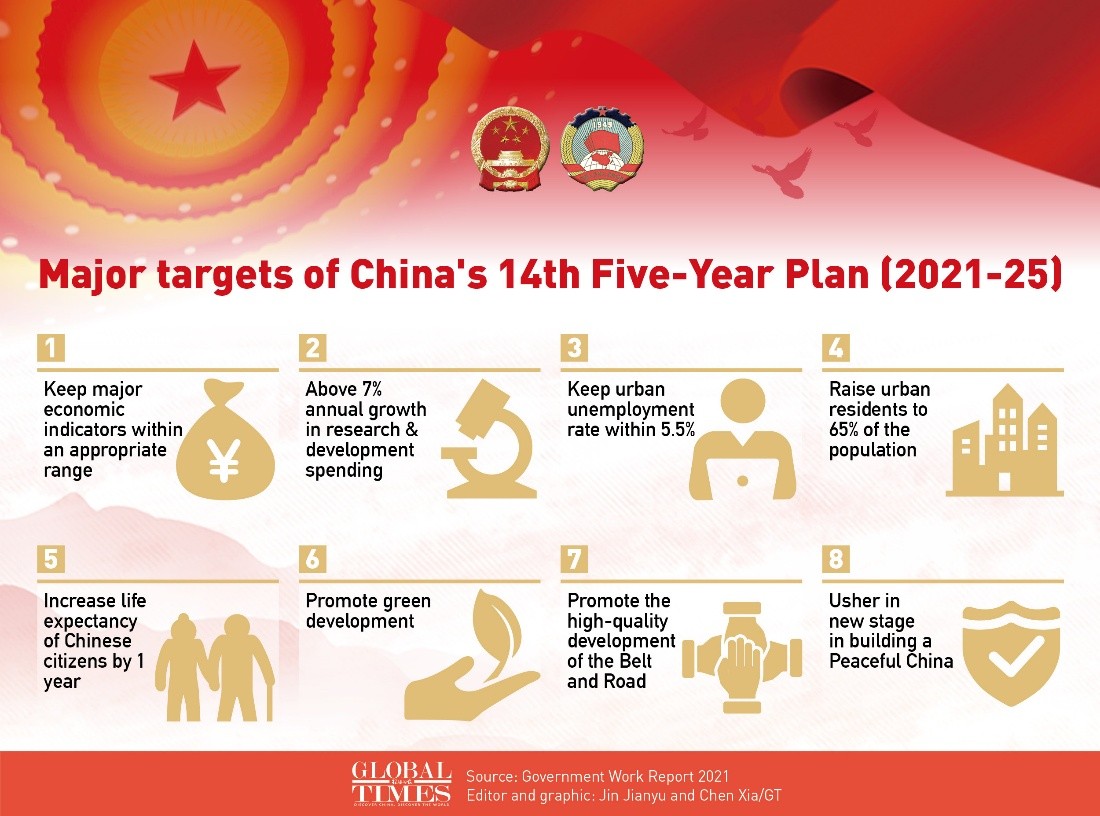
China’s approach to long-term national planning is not a Communist relic. It is a sophisticated institutional practice that its leadership has updated and refined across generations. The current Five-Year Plan, the 14th, runs through 2025 and encompasses semiconductor independence, renewable energy dominance, AI research leadership, rural poverty elimination, and infrastructure investment in emerging markets through the Belt and Road Initiative.
The decisions that produced China’s current manufacturing dominance were made in the 1980s and 1990s, when Deng Xiaoping’s government decided to become the assembly floor of the global economy and invested in the infrastructure, education, and labor policy to make that happen over a 30-year arc. Nobody in those planning meetings was worried about a midterm election.
[China’s 14th Five-Year Plan — strategic goals across technology, manufacturing, and infrastructure set on decade-long timelines. Source: Global Times / State Council of China]
The results are not subtle. According to the World Bank, China now produces over 28 percent of global manufacturing output. It accounts for more than 70 percent of global solar panel production, over 80 percent of the world’s lithium battery supply chain, and is closing the gap on semiconductor fabrication at a rate that U.S. export controls are straining to slow. These are not accidents. They are the outputs of decisions made one, two, and three decades ago.
What Does a 4-Year Plan Look Like?
The American political cycle produces a very specific kind of governance. Every major policy initiative gets filtered through one question: will this help or hurt the party in the next election? Infrastructure investments that take a decade to deliver returns get shelved because the ribbon-cutting will happen on someone else’s watch. Healthcare reforms that require five years of restructuring to show savings get abandoned because the disruption is visible immediately and the benefit is not. Climate investments that pay off in 2040 get stripped from budgets to reduce the deficit number heading into November.
This is not a character defect in our politicians. It is a structural output of a system that ties every decision to a two or four-year accountability horizon. The incentive is to solve problems that show results before the next election, and to defer problems whose solutions show results after it.
The Center Forward Party’s Specific Goals page makes this case directly: reducing the debt, balancing the budget, and restructuring welfare all require decisions whose full payoff is five to ten years out. No election-cycle-dependent legislator has the structural incentive to make those decisions unless an institutional framework forces the horizon to extend.
Is the Debt the Clearest Proof of This Problem?
Yes. The national debt has crossed $39 trillion. According to the Congressional Budget Office, interest payments on that debt are projected to reach $1 trillion in fiscal year 2025 and will exceed $2 trillion by 2035. Within a decade, interest payments will surpass what the United States spends on defense. Within two decades, they will be the largest single line item in the federal budget.
Every Congress for forty years has known these projections. Every Congress for forty years has continued to add to the debt rather than address its trajectory, because the political pain of deficit reduction falls inside the election window and the benefit arrives outside it. The math has been plain for decades. The political incentives have been equally plain. And the incentives have won every single time.
A third party that holds the balance of power in Congress, and whose candidates are not running on a two-year reelection timeline but on a longer-range reform mandate, changes that calculus. The Center Forward Party does not need to be the majority. It needs to be the decisive centrist bloc that neither major party can govern without.
What Would Actual Long-Term Governance Look Like?
Here is what the Center Forward Party’s structural reforms would allow that the current system cannot:
- An annual legislative review by the Central Apolitical Organization that checks every active law against its intended outcomes, adjusting what is not working before failures compound over decades
- A debt reduction roadmap built on a ten-year horizon, not a two-year budget window, with independent cost verification at every stage
- Welfare reform structured around a five-year transition arc that lets recipients work without losing benefits, letting the savings accumulate over a decade rather than demanding immediate fiscal impact
- Infrastructure investment budgeted across a 20-year capital plan, not subject to elimination in the next appropriations cycle
- AI and labor market disruption addressed proactively, through legislation drafted by the Central Apolitical Organization before the displacement wave peaks, not reactively after millions of jobs have disappeared
None of these things are impossible. They are impossible inside a system where every decision gets measured against the next election. Outside that constraint, they are just management.

[China’s Belt and Road Infrastructure Investment Strategy versus U.S. short-cycle planning — the compounding divergence in long-term strategic positioning.]
The countries winning the next fifty years are the ones that can make a decision today about where they want to be in 2075 and build a policy architecture to get there. America has never been less capable of that than it is right now, inside a political system that has fully calcified around 2-year and 4-year horizons.
Why a Third Party Changes the Equation
The two major parties cannot break this cycle on their own, because both are fully adapted to it. Their fundraising, their messaging, their candidate recruitment, and their internal power structures are all calibrated to the election cycle. Asking either party to adopt a 20-year planning horizon is asking them to dismantle the machinery they use to stay in power.
A third party that enters Congress as a decisive centrist bloc can force both sides to negotiate on longer timescales, because the votes required to pass anything run through a party whose candidates ran explicitly on structural reform. The Center Forward Party’s candidates will not be asking their donors whether a 20-year infrastructure plan is good for their portfolio. They will be asking whether it is good for the country, as evaluated by an apolitical body of experts who will not be running for anything in 2026.
That is a different kind of political will than either major party can currently generate. And it is the kind that actually produces the long-range decisions America needs.
If you are ready to support governance that thinks beyond the next news cycle, contact us here and help us build the centrist bloc that finally changes what Congress is capable of delivering.
Frequently Asked Questions
Q1) Is long-term planning compatible with democracy?
Long-term planning does not mean unaccountable governance. It means setting goals with a longer horizon and evaluating progress annually. Democracies like Germany, Sweden, and New Zealand operate with 10 and 20-year policy frameworks while remaining fully accountable to their voters.
Q2) What stops a future Congress from undoing long-term reforms?
Nothing, legally. But the electoral strategy of the Center Forward Party is to build a large enough centrist bloc that undoing structural reforms becomes politically costly. The reforms also need to generate visible results within a few years to build durable public support.
Q3) Does China’s model involve authoritarian control we should not import?
The lesson from China is not to import its authoritarian governance. It is to import the concept of a national planning horizon longer than four years, applied within a democratic framework. The two are entirely separable.
Q4) Why have neither party addressed this already?
Because both parties benefit from the current system’s short-termism. It keeps the electorate focused on immediate grievances rather than structural failures, which serves the fundraising and messaging machine that both parties run on.
Q5) What is the Center Forward Party’s concrete timeline for introducing these reforms?
The strategy is to win enough congressional seats in the midterms to hold the balance of power in Congress, then use that leverage to make structural reforms, including the Central Apolitical Organization and long-term debt reduction planning, conditions of the party’s support for any legislative agenda.