I want to start with a number that should be in every major policy conversation about the U.S. economy in 2026 and is almost never mentioned in that context. The total annual economic cost of gun violence in the United States is $557 billion, approximately 2.6 percent of GDP. The per capita burden is roughly $1,690 per person per year.
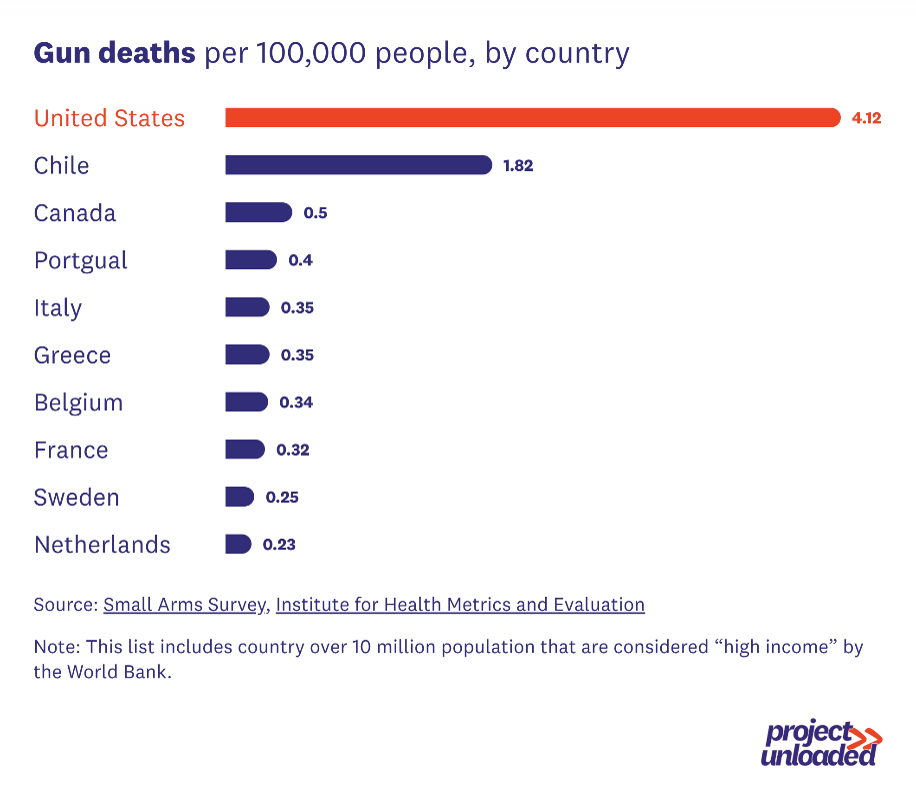
To put that in context: the entire European Union, with a population of approximately 450 million people, generates a total firearm mortality rate of between 0.7 and 1.2 deaths per 100,000 people per year. The United States generates a rate of 10 to 14 deaths per 100,000 per year, depending on the methodology. The U.S. firearm homicide rate alone is approximately 22 times higher than in the EU, at 4.1 per 100,000 compared to 0.19 per 100,000.
The economic cost disparity that follows from that mortality gap is enormous. American taxpayers fund 84 percent of firearm injury medical costs through publicly funded programs including Medicaid and uncompensated hospital charity care. The European healthcare systems that absorb the medical cost of gun violence do not notice the expense in their national budgets because the volume of gun violence is so low.
This is not a marginal policy difference between two comparable approaches. It is a catastrophic structural failure with a cost measured in hundreds of billions of dollars annually and in 45,000 lives per year.
What the Public Actually Supports in 2026
The political debate around gun control in the United States has been distorted by the National Rifle Association’s influence on congressional campaign finance to a degree that has produced a legislature dramatically out of alignment with the electorate it represents. The polling data is unambiguous:
- 87 percent of Americans support universal background checks for all gun buyers, including 83 percent of gun-owning households
- 80 percent support red flag laws allowing police to temporarily remove firearms from individuals deemed a danger to themselves or others
- 74 to 81 percent support safe storage requirements
- 72 percent support requiring a specific license or permit before purchasing any firearm
- 52 to 61 percent support a nationwide ban on assault rifles
- 54 to 75 percent oppose open carry of firearms in public spaces
These are not marginal majorities. These are supermajority positions in a country that cannot pass a universal background check bill through the Senate, because 41 senators representing states funded by NRA campaign dollars are sufficient to sustain a filibuster against legislation that 87 percent of the population supports.
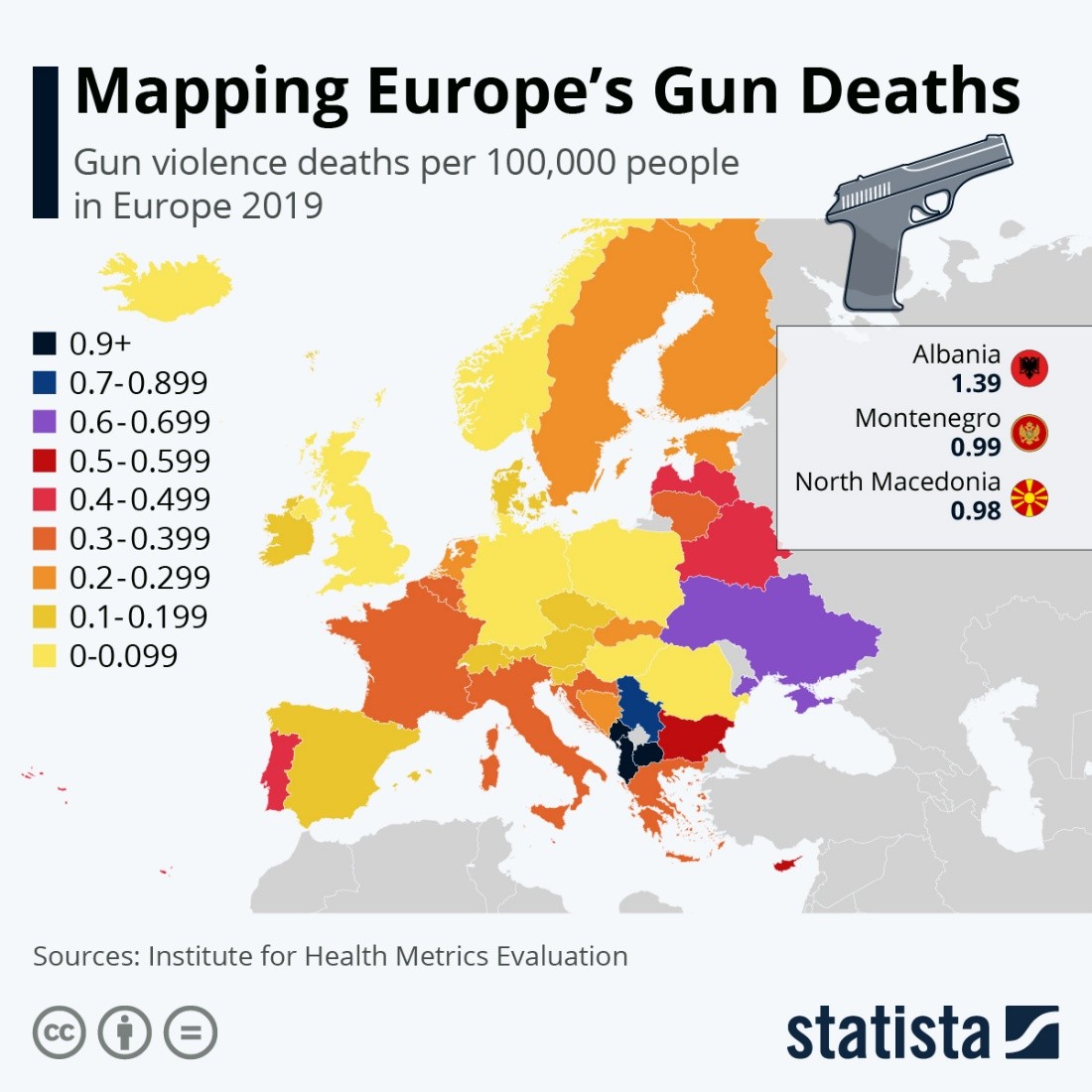
![US gun death rate vs Europe comparison — the US firearm mortality rate at 10-14 per 100,000 is 20 times higher than the European average of 0.7-1.2 per 100,000, generating a $557 billion annual economic burden. Source: Statista / Science Direct / Harvard Medical School]
What the Geopolitical Context Adds
The United States is trying to compete economically and geopolitically with China, which is growing at 4.41 percent in 2026, and India, which is growing at 6.6 percent, while carrying a $557 billion annual self-inflicted economic wound from a policy failure that 87 percent of its own population has indicated it wants to fix.
From a pure competitiveness standpoint, this is a staggering misallocation. The $557 billion in annual gun violence costs, including $50 billion in workplace productivity losses, $1 billion to $1.57 billion in emergency room and inpatient medical costs, and the massive criminal justice and incarceration costs associated with gun-related crime, represent economic capacity that is destroyed annually because the legislative process cannot produce the majority-supported reforms that would reduce the violence rate.
China’s government does not face this constraint. Its central committee makes long-range infrastructure and economic plans without having to navigate a Senate filibuster funded by an industry lobby. Its economic advantages over the United States are structural as well as technological.
Why the Current Legislative Structure Prevents the Fix
The filibuster is the specific mechanism that prevents majority-supported gun legislation from becoming law. A 60-vote supermajority is required to advance legislation in the Senate. The NRA and aligned organizations have sufficient campaign finance leverage over 41 senators to sustain the filibuster against any major gun safety legislation.
This is not a disagreement about policy outcomes. 87 percent public support for universal background checks is not a contested empirical finding. It is a donor-funded blockade of legislation that has already won the policy debate with the public.
The Center Forward Party’s structural reforms address this problem at multiple levels simultaneously. Eliminating the filibuster removes the specific procedural mechanism that 41 donor-backed senators use to block majority-supported legislation. The campaign finance and salary reforms reduce the financial dependence on NRA contributions that motivates the filibuster in the first place. The Central Apolitical Organization’s review process would assess gun violence legislation against outcome data, making the cost of inaction part of the formal public record rather than an external critique that can be ignored.
What Sensible Gun Reform Would Actually Look Like
The Center Forward Party supports a comprehensive but specifically targeted set of reforms that reflect where the public already is on this issue:
- A mandatory firearms license for any person purchasing a gun, requiring completion of a safety course and passing of a background check, analogous to a driver’s license
- A minimum age of 21 for all firearm purchases
- A ban on open carry in public spaces, reflecting the 54 to 75 percent public opposition to it
- Psychological testing as part of the licensing and renewal process
- Red flag laws nationally, allowing temporary removal of firearms from individuals demonstrating risk factors
- An outright ban on the sale and manufacture of semi-automatic assault rifles, consistent with the 52 to 61 percent public support for such a ban
- Safe storage requirements for all registered firearms
These reforms are not constitutionally radical. The Second Amendment has never been interpreted by any serious legal scholar as providing an unlimited right to any type of firearm in any location without any qualification. The current interpretation, shaped heavily by the political composition of a court whose members were nominated by administrations in part funded by the gun lobby, is not the only constitutionally defensible interpretation.
The Trump Administration’s Position and Its Costs
The current administration’s approach to gun control has been consistent with the NRA’s legislative priorities rather than with the 87 percent of Americans who support universal background checks. In a 2026 geopolitical environment where the United States is trying to project institutional credibility to European allies, to India as a potential trade partner, and to a domestic electorate that is 45 percent independent and deeply frustrated with dysfunction, the persistence of a gun violence crisis that costs $557 billion annually and kills 45,000 people per year while 87 percent of the public supports the fix represents a specific and measurable governance failure.
The European Union, which the United States is trying to maintain as a strategic ally in competition with China and Russia, has a firearm mortality rate 10 to 20 times lower than the United States. American gun violence is not just a domestic tragedy. It is a reputational and economic liability in a global context.
Conclusion
The $557 billion annual economic cost of gun violence in the United States is the most expensive preventable policy failure in the American budget. It is sustained by a combination of the filibuster, the NRA’s campaign finance leverage over 41 senators, and the absence of an independent review body that would put the cost of legislative inaction on the formal public record.
The Center Forward Party’s structural reforms, including filibuster elimination, salary and accountability reform, and the Central Apolitical Organization, are the specific mechanisms that would allow the will of the 87 percent to finally override the donor leverage of the few.
Visit thecenterforwardparty.com to read the full gun reform position, and join the movement here.