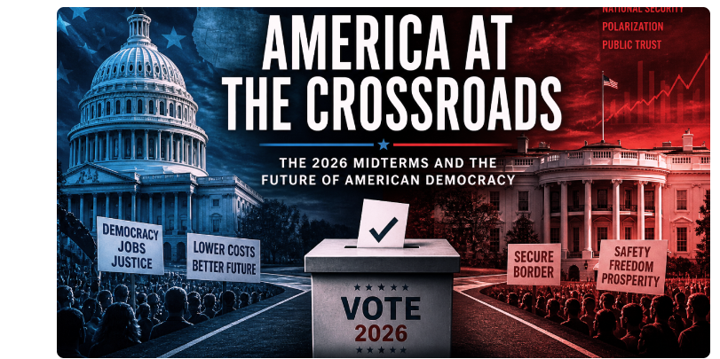
There is a specific quality to political moments that, in retrospect, everyone recognizes as having been the inflection point where the direction of things changed. Sometimes that inflection point is visible in advance. The Center Forward Party believes the 2026 midterms are exactly that kind of moment, and the data available right now, from independent voter identification records to global economic positioning to Trump administration approval ratings among the decisive independent bloc, supports that reading with unusual precision.
Let me lay out the case specifically.
What the Voter Data Shows in 2026
A record-high 45 percent of Americans identified as political independents in 2025, according to Gallup, the highest figure since Gallup began measuring in 1988. Republicans and Democrats each sit at 27 percent. The largest partisan identification category in the United States is not either major party. It is the people who have rejected both.
A July 2026 national survey of 1,000 U.S. adults found Republican voters significantly more open to independent candidates than in earlier polling waves, with the partisan gap in openness to independent alternatives closing substantially. Trump’s approval rating among registered independents in an August 2026 YouGov/Economist poll stands at 25 percent. The generic congressional ballot shows Democrats leading 42.1 percent to 37.3 percent, with independents taking 6.3 percent and a large share still undecided.
The June 2026 Independent Center Voice national survey found that 69.5 percent of Americans say they would be likely to vote for a strong, well-funded independent candidate who shared their views and was willing to work across the aisle. Only 6.3 percent currently pick an independent or third-party candidate on the generic congressional ballot. Two things stand between those two numbers: low awareness and a residual spoiler reflex. Both are addressable.
What the Economic Context Creates
The 2026 economic environment is generating exactly the kind of voter frustration that creates appetite for structural political change.
U.S. real GDP grew at 1.5 percent in the second quarter of 2026, slowing from 2.1 percent in the first quarter. The fiscal year 2026 deficit totaled $1.8 trillion in the first ten months, $169 billion wider than the same period a year earlier. Tariff policy, changing more than 50 times since January 2025, has generated a $250 billion revenue shortfall and added $0.9 trillion to the projected ten-year deficit.
Meanwhile, the Budget Lab at Yale calculated that American families face an average of $1,560 in additional annual costs from tariff-driven price increases. For the median household earning approximately $80,000, that is nearly 2 percent of pre-tax income consumed by the consumer price effects of a trade policy that has not delivered its promised fiscal benefits.
Gallup’s 2026 forecast found that Americans’ predictions for 2026 were considerably more negative than for 2025, with double-digit declines in positive predictions for employment, taxes, economic prosperity, and the stock market. An electorate that is simultaneously the most independent in recorded history and the most economically pessimistic in recent memory is an electorate that is structurally available for an alternative.

![Record 45% of Americans now identify as independents — the 2026 midterms represent the clearest opening for third-party electoral viability in decades. Source: Gallup / ABC News]
What the Geopolitical Moment Adds
The United States faces a specific geopolitical reality in 2026 that makes governance quality more consequential than at any point in recent decades. China is growing at 4.41 percent while the United States grows at approximately 2 percent. China and India together account for 43.6 percent of global real GDP growth. The global economy is projected at $126 trillion in 2026, with the United States contributing roughly $32.4 trillion, a share that has been declining relative to China and India as those economies grow faster.
Europe is watching American trade policy chaos, the 50-plus tariff changes, the Supreme Court IEEPA ruling, and the $250 billion revenue shortfall, with a combination of alarm and strategic calculation. India is building bilateral trade relationships with the UK and EU specifically to reduce its dependence on the U.S. market, which has been made unstable by tariff volatility.
The United States needs a government capable of making sophisticated, long-range decisions about trade relationships, technology competition, defense posture, and fiscal management. The two parties that have produced the current situation, the $36 trillion debt, the tariff chaos, the legislative dysfunction, and the $557 billion annual gun violence cost, are not capable of producing that quality of governance from within their current structures.
Why the Center Forward Party’s Strategy Is Specifically Calibrated for 2026
The Center Forward Party is not trying to win a presidential election. The strategy is to win enough congressional seats to hold the balance of power, so that neither the Republican nor the Democratic caucus can pass legislation without the CFP’s votes. A decisive centrist bloc of 30 to 40 House members is the lever that forces structural reform into the legislative agenda.
The targeted districts are the competitive suburban and exurban seats in Pennsylvania, Michigan, Arizona, Georgia, and Nevada, where independent voters, now the largest partisan identification category nationally, determine outcomes. Trump’s 25 percent approval among registered independents in August 2026 means that any competitive district where the CFP can field a credible candidate is a district where the political arithmetic is genuinely open.
The candidates who carry the CFP’s banner in 2026 will have committed to the full structural reform platform: qualification standards for legislators, the Central Apolitical Organization, salary and accountability reform, filibuster elimination, mandatory competitive bidding, welfare-to-work redesign, HSA-Medicare integration, and gun safety reform reflecting the supermajority positions of the American public.
They will have agreed to have their official meetings on record before the enabling legislation passes, as a signal to voters that the accountability standard the party advocates for is one its own candidates are willing to apply to themselves.
The Case for Acting Now
The window for a centrist third party to enter American politics with sufficient momentum to win congressional seats is not permanent. The conditions that currently make it favorable, record independent identification, record economic pessimism, record openness to independent alternatives, and a Trump administration approval rating among independents at 25 percent, are specific to this electoral moment.
In 2028, the presidential election will dominate political attention and compress the space for third-party congressional candidates. In 2030, redistricting will reshape the competitive district map. The 2026 midterms are the most structurally favorable moment for the Center Forward Party to build its initial congressional presence.
The 69.5 percent of Americans who say they would vote for a strong independent are not waiting for a reason to want this. They are waiting for an organization credible enough to trust, a platform specific enough to evaluate, and candidates visible enough to know. The Center Forward Party is building all three.
Conclusion
The 2026 midterms are the clearest political opportunity in a generation for the structural reform the American political system requires and that its voters have consistently said they want. The economic data, the voter identification data, the approval rating data, and the geopolitical context all point toward the same conclusion: the moment for a credible centrist third party is now, not in four years, and not in the abstract.
The Center Forward Party is building the candidates, the platform, and the institutional credibility to make the 69.5 percent who say they want an independent alternative into the voters who deliver one.
Join the Center Forward Party at thecenterforwardparty.com and take the first step toward the midterm that changes American governance here.