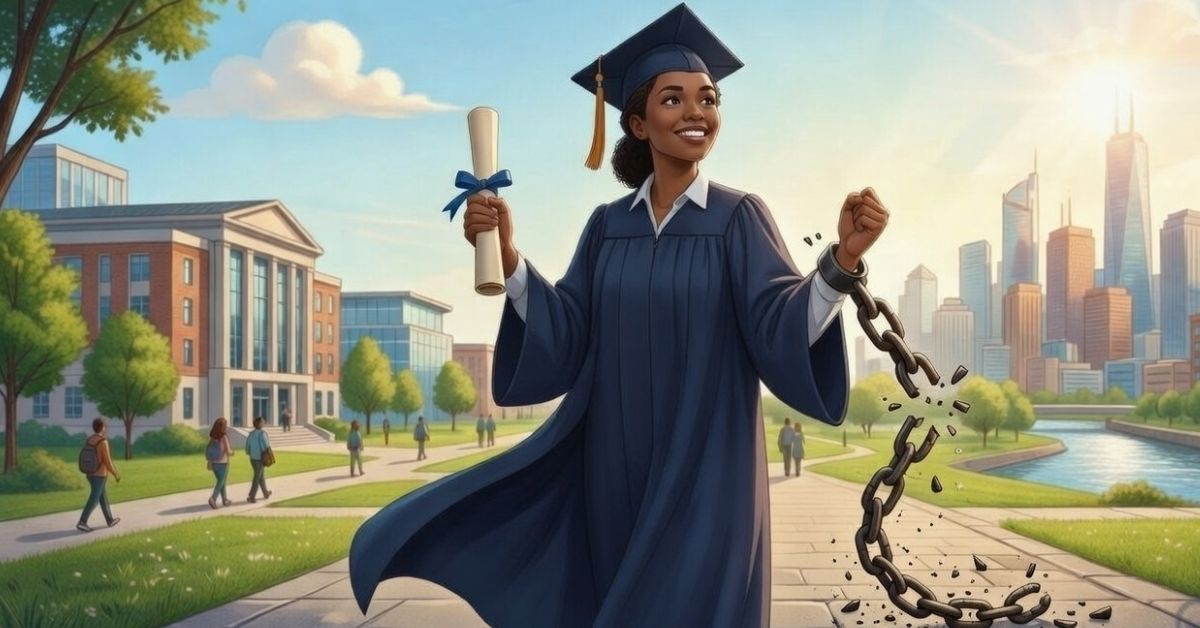
The American higher education system, once the undisputed engine of global opportunity, has reached a point of systemic crisis. For decades, we have operated under the assumption that more debt equals more opportunity. Today, that assumption lies in ruins. The ballooning cost of tuition has forced millions of qualified citizens to choose between crippling financial servitude and foregone education—a choice that jeopardizes our nation’s competitive edge in an AI-driven global economy.
At the Central Forward Party, we believe that finding a sensible, fiscally responsible, and effective solution for Free College and Technical Education is not a “handout.” It is a critical, long-term investment in the nation’s human capital. However, to make this vision a reality, we must confront the uncomfortable truths about why costs have spiraled and how we can realistically fix them for workers of all ages.
The Moral Hazard: Why Blank Checks Failed the Student
The current student debt crisis, totaling $1.8 trillion, is a symptom of a profound “moral hazard.” Over the last forty years, the federal government has effectively provided an uncapped line of credit to eighteen-year-olds. Universities, realizing that students had access to nearly unlimited borrowing, responded by increasing tuition at rates that vastly outpaced inflation.
We must be honest: many colleges increased their tuition simply because the borrowing limit allowed it. This has created an environment where the “prestige” of a campus often matters more than the employability of its graduates. The Central Forward Party proposes a fundamental decoupling of education from predatory lending through two key mechanisms:
- Career-Goal Borrowing Limits: We must align borrowing power with reality. It is a mathematical and moral failure to allow a student to borrow $200,000 for a degree in the fine arts or philosophy, where the statistical ability to repay such a debt is extremely low. Under our plan, federal borrowing limits will be tied to the Projected Return on Investment (ROI) of a specific major.
- Restoring Bankruptcy Protections: There is a common fear that allowing student debt to be discharged in bankruptcy would lead to every graduate filing for insolvency. We reject this. By lowering the amount students can borrow based on their career goals, we drastically reduce the cost of the education itself, making the debt manageable. Restoring bankruptcy rights acts as a necessary “safety valve” that forces lenders and institutions to have “skin in the game.” If a university produces graduates who cannot pay their debts, the institution—not just the taxpayer—should bear the financial consequences.
The “Last-Dollar” Model: Fiscally Responsible Access
The notion of “free college” is often dismissed as a radical expense. However, a pragmatic approach focuses on the truly needy through the “Last-Dollar” Model.
Under this plan, the federal government would focus funding on covering any remaining tuition and fees at public institutions after a student’s existing federal and state aid (like Pell Grants) has been applied.
- Efficiency: This model is significantly more affordable than universal “first-dollar” plans, with an estimated first-year cost of $28 billion.
- Equity: It strategically directs resources to low- and middle-income students who otherwise could not afford to attend, while ensuring that wealthier families continue to contribute their fair share.
Technical Education: The Bridge for the 50+ Workforce
A critical flaw in the modern educational debate is the obsession with the four-year degree. We must recognize that for a significant portion of the American workforce, a traditional college campus is not the answer.
We must speak directly to the workers who feel left behind: the coal miners, the assembly line workers, and the professionals over the age of 50 whose industries are being disrupted by AI. It is unlikely that a 55-year-old former miner wants to pursue a Bachelor’s in Sociology. They want, and need, Technical Education that honors their existing skills and leads to immediate, high-paying work.
Our “Technical Empowerment” pillar includes:
- Vocational Parity: Free technical and vocational training will be funded at the same “last-dollar” rate as community colleges.
- Re-tooling the Rust Belt: We will establish specialized centers for advanced manufacturing, renewable energy installation, and logistics tech—skills that use the mechanical aptitude of our legacy workforce but apply them to 21st-century hardware.
Tying Education to Welfare and Unemployment Reform
Education is only half of the equation; the other half is the demand for labor. To ensure that our newly trained workforce finds homes in the private sector, we must integrate education with our broader economic reforms.
- The Hiring Incentive: We propose a Double Tax Deduction for any company that hires an individual who has completed a state-funded technical or college program after 6 months of unemployment. This turns a “high-risk” hire into a major financial asset for the employer.
- The 50% Wage Bridge: We will reform welfare so that recipients do not lose their benefits the moment they find work. Instead, they can keep their full welfare support plus 50% of their new wages until their household income reaches three times the poverty level. This gives workers the financial breathing room to finish their certifications or degrees without the fear of falling off a “benefits cliff.”
The Economic Upside: Innovation over Indebtedness
This investment is not a cost; it is an economic stimulus. Research consistently shows that making education more accessible boosts the average lifetime earnings of graduates by over $1 million compared to those with only a high school diploma.
By implementing these changes, we achieve a triple benefit:
- Lowering Costs: By capping borrowing and forcing institutional accountability, we stop the hyper-inflation of tuition.
- Boosting Revenue: A more highly skilled workforce pays more in taxes and relies less on social services.
- National Security: In a world where China is aggressively investing in STEM and technical labor, America cannot afford to have its best minds sidelined by a lack of funds or a surplus of debt.
Conclusion: A Smarter Way Forward
The Central Forward Party is not advocating for wasteful spending or “free everything.” We are advocating for a system where the cost of education is disciplined, where debt is tied to reality, and where training is accessible to every American—whether they are eighteen or fifty-eight. By implementing a targeted “last-dollar” plan and a robust technical education mandate, we ensure our human capital remains the richest in the world. This is the only way to meet our social responsibilities while simultaneously moving toward a balanced national budget.