
There is a line of economic reasoning that has been sold to the American public in various forms since the early 1980s. It goes roughly like this: if you reduce the tax burden on wealthy individuals and corporations, those savings will flow back into the economy as investment, job creation, and ultimately higher wages for everyone below them. The technical name for it is supply-side economics. The common name, which even its proponents sometimes use, is trickle-down.
The data on whether it has worked is now substantial enough that the debate is less about the theory and more about why the theory persists despite the evidence against it.
Since 1980, the top marginal federal income tax rate has fallen from 70 percent to 37 percent. The corporate tax rate fell from 46 percent in 1980 to 21 percent after the 2017 Tax Cuts and Jobs Act. Over that same period, real wages for the median American worker have grown by approximately 17 percent according to the Bureau of Labor Statistics, while productivity has grown by over 60 percent. The gains from that productivity growth went almost entirely to capital rather than labor. The top 1 percent’s share of total income has risen from roughly 10 percent in 1980 to approximately 19 percent in recent years according to World Inequality Database data.
This is not a case of a theory that has not been tested. It is a case of a theory that has been tested for forty years at scale and has produced a measurable outcome that diverges significantly from what the theory predicted.
What Does the Data Show About Middle Class Spending Power?
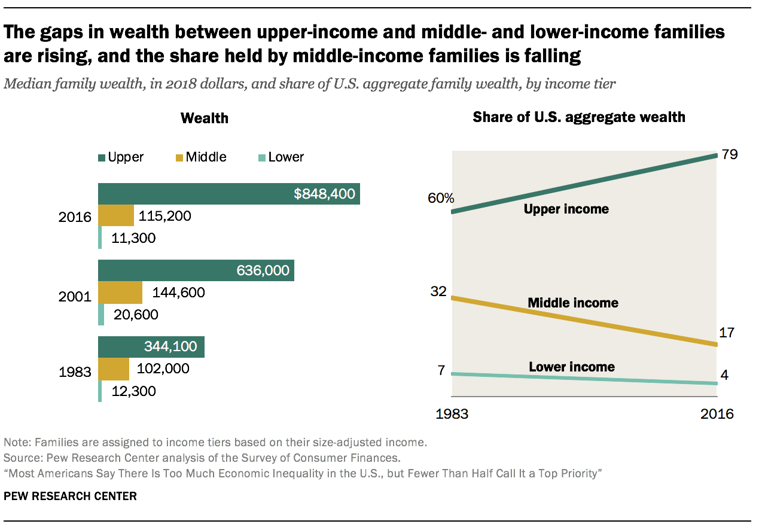
[Pew Research Center data on income and wealth inequality in the United States — the growing gap between middle-income and upper-income families over four decades of supply-side tax policy. Source: Pew Research Center]
Consumer spending accounts for approximately 68 percent of U.S. GDP according to the Bureau of Economic Analysis. That is the foundational economic fact from which everything else in this argument follows.
GDP grows when people spend money on goods and services. Businesses invest and hire when they anticipate that spending. The question of who should receive tax relief and income support is not primarily a moral one in the economic context. It is a question of who, when they receive an additional dollar, is most likely to spend it back into the economy rather than save or invest it in ways that do not directly drive domestic consumption.
The answer to that question has been empirically consistent across multiple economic research traditions. Lower-income and middle-income households have a higher marginal propensity to consume than higher-income households. This means that a dollar transferred to a middle-income family is more likely to be spent at a local business, on housing, on food, on education, or on healthcare, than a dollar transferred to a high-income family, which is more likely to be saved, invested in financial instruments, or parked in assets that do not directly generate domestic economic activity.
The Federal Reserve Bank of San Francisco estimated in research published after the 2020 stimulus payments that consumption propensity from lower-income recipients was substantially higher than from higher-income recipients, consistent with the long-standing academic consensus on this relationship.
Why Does Tax Relief for the Wealthy Not Produce the Promised Investment?
The theoretical mechanism for trickle-down economics is that wealthy individuals and corporations, retaining more of their income through lower taxation, will invest those retained earnings in businesses that create jobs and raise wages. This is not an irrational theory on its face. Investment does produce economic activity. The problem is that the theory depends on investment being the primary constraint on business expansion. And in most economic conditions, it is not.
Businesses invest when they anticipate demand. A manufacturer does not build a new factory because their taxes went down. They build a new factory because they believe there will be customers for the products the factory produces. If the middle class, which is the primary customer base for most consumer goods and services, does not have sufficient spending power to create that demand, the tax savings from a rate cut will not produce investment. They will produce share buybacks, executive compensation increases, dividend payments, and asset purchases, all of which are documented outcomes of the 2017 Tax Cuts and Jobs Act.
According to research by the Federal Reserve, corporate share buybacks surged to record levels in 2018 following the TCJA’s passage. Investment in plant and equipment, which was the stated purpose of the corporate tax cut, increased modestly and then returned to its prior trend within two years. The promised wage growth for median workers materialized at levels well below what the tax cut’s proponents forecast.
This is not a partisan reading of the data. It is what the data shows.
What Happens When You Strengthen the Middle Class Instead?
The alternative argument, which the Center Forward Party advances, is that the most reliable driver of broad-based economic growth is a middle class with sufficient income and spending power to sustain consumer demand at the level required to justify business investment and job creation.
This has a specific policy implication. Tax relief concentrated at middle income levels, roughly $40,000 to $150,000 in annual household income, produces higher rates of economic activity per dollar of tax reduction than equivalent relief concentrated at the top. The mechanism is direct: middle-income households spend a higher proportion of their income, that spending creates revenue for businesses, businesses respond to that revenue by investing and hiring, and the cycle generates economic growth more broadly.
The evidence from the 2020 and 2021 stimulus payments is instructive in this regard. The National Bureau of Economic Research published multiple studies documenting the rapid transmission of direct payments to low and middle-income households into consumer spending within weeks of receipt. Retail sales, food service revenue, and small business income all showed measurable increases in the weeks following each payment round, concentrated in communities with lower average incomes where the marginal propensity to spend was highest.
This is the economic mechanism the Center Forward Party builds its tax and fiscal policy around. Progressive taxation that increases effective rates above $500,000 in annual income, combined with reduced rates for middle-income households, is not a redistribution argument. It is an economic efficiency argument. You are redirecting the marginal dollar from a use, high-income saving and investment in financial assets, that produces modest domestic economic activity, to a use, middle-income consumption, that produces substantially more.
What Is the Actual Cost of Wealth Concentration at the Top?

[Wealth inequality in the United States — the top 1 percent’s share of total wealth has grown substantially since 1980, while middle-class wealth share has declined. Source: Federal Reserve Distributional Financial Accounts]
This question is rarely framed this way in public debate, but it is the right framing. Wealth concentration is not simply an equity concern. It has measurable economic costs that fall broadly across the economy, including on the wealthy themselves.
When a significant and growing share of national income concentrates in households with low marginal propensity to consume, the economy’s capacity for self-sustaining growth through domestic demand weakens. The Federal Reserve’s own Distributional Financial Accounts show that the top 1 percent now hold approximately 30 percent of total U.S. household wealth, while the bottom 50 percent hold approximately 2.5 percent.
An economy where the bottom 50 percent of households control 2.5 percent of wealth is an economy that is structurally dependent on debt-financed consumption by the middle class to sustain demand. That is precisely the structure that produced the 2008 financial crisis: a middle class that had insufficient income growth to sustain its consumption without borrowing, borrowing at rates that eventually became unsustainable, and a financial system that had built its business model around that unsustainable borrowing.
The wealthy are not insulated from the consequences of that dynamic. The 2008 crisis destroyed substantial wealth at every income level. A more broadly shared distribution of income and purchasing power produces a more stable demand base, which is ultimately better for asset values, business revenue, and long-range investment returns than an economy that concentrates gains at the top until demand collapses.

What Does the Center Forward Party Actually Propose?
The tax framework is specific. For households earning below $100,000 annually, we propose a federal income tax rate reduction of five percentage points across all applicable brackets. For households earning between $100,000 and $500,000, current rates apply. For income above $500,000, marginal rates increase progressively to a maximum of 50 percent on income above $2 million. The corporate rate remains at 21 percent but with the elimination of the specific provisions, accelerated depreciation, offshore profit treatment, and industry-specific carve-outs, that allow effective corporate rates to fall well below the statutory rate for the largest firms.
These provisions also include what the Center Forward Party describes as the welfare-to-work reform: allowing welfare recipients to take employment without immediately losing benefits, with benefits phasing down gradually as earnings rise. This removes the benefit cliff that currently makes low-wage work financially irrational for many welfare recipients, expands the effective labor supply, reduces the long-range cost of the welfare system, and puts income into the hands of households with the highest marginal propensity to spend it back into the economy.
The combination of middle-class tax relief, progressive rates on top earners, corporate rate rationalization, and welfare-to-work reform is estimated, based on the Center Forward Party’s own analysis drawing on CBO scoring methodology, to reduce the annual deficit by approximately $200 to $300 billion over a ten-year implementation period, while generating GDP growth that partially offsets the revenue impact of the middle-class rate reductions.
The Argument That Follows for Anyone Paying Attention
The case for stimulating the middle class is not a left-wing argument. It is a business argument. An economy with 330 million active consumers generating sufficient income to drive domestic demand is a better business environment than an economy where 330 million people are technically present but 50 percent of them control 2.5 percent of the wealth.
The wealthy have done well in the current system. The question is whether they would do better in a system where the middle class was a more robust source of demand for their businesses, their real estate, their products, and their services. The answer, supported by both economic theory and the empirical record of the post-World War II period when top marginal rates were much higher and middle-class growth was much faster, is almost certainly yes.
The Center Forward Party is building the political vehicle that can make that argument from inside Congress rather than from outside it. If you believe that an economy that works for the middle class ultimately works better for everyone, join us here.